Kudremukh Trek:
The Complete Guide (2026)
If trekkers in Karnataka know one trek by name, it's this one. Kudremukh — "horse face" in Kannada, named for the silhouette its summit ridge cuts against the sky — is a 16–22 km round trip through rolling shola grassland, dense forest, and river valleys inside Kudremukh National Park, Chikmagalur.
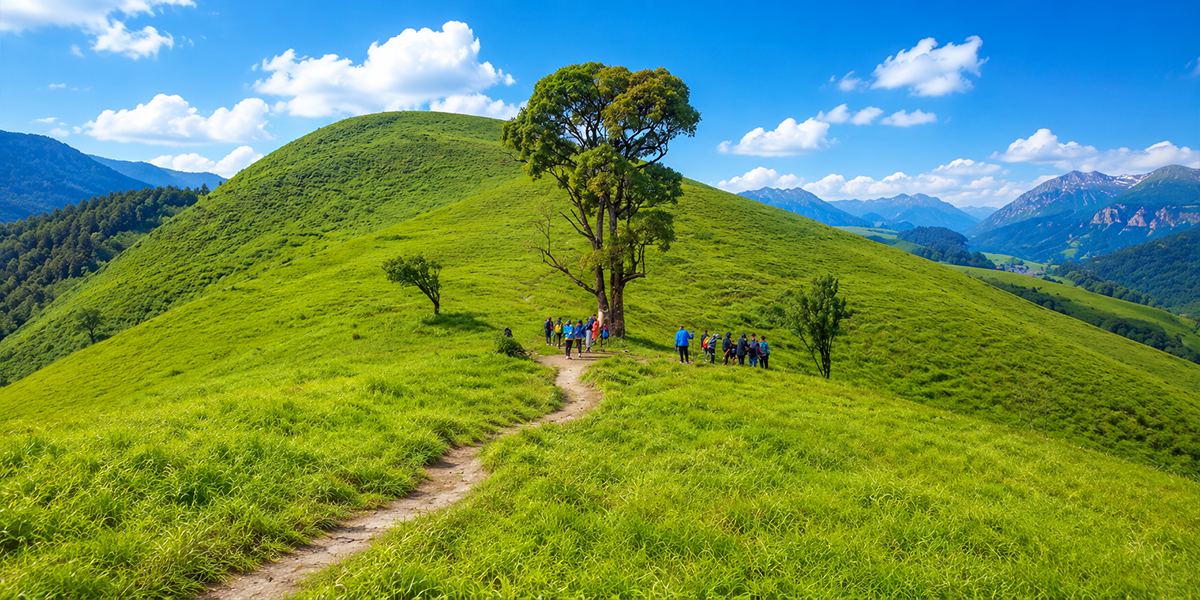
At 1,894 m, it's Karnataka's third-highest peak, and unlike most single-summit treks, almost the entire route delivers views, not just the last kilometre.
This guide pulls together what the current top-ranking pages leave scattered or outdated: the 2026 Aranya Vihaara permit overhaul, a real DIY-vs-guided cost comparison, the park's genuinely fascinating conservation history, and the safety details that matter on a remote 6–9 hour trail with no washrooms and patchy signal. If you're deciding between this and its quieter neighbour, we've also covered Netravati Trek — see the comparison table below.
At a Glance: Key Trail Metrics
Location
Mullodi village, near Kalasa, Chikmagalur
Peak Altitude
1,894 m (6,214 ft)
Duration
6–9 Hours on Trail
Trip Length
2 Days / 1-2 Nights
| Extended Trail Specifications | |
|---|---|
| Falls under | Kudremukh National Park (Kudremukh Wildlife Division) |
| Rank in Karnataka | 3rd-highest peak, after Mullayanagiri and Baba Budangiri |
| Round-trip distance | 10+10 in total 20 KM two way trek |
| Permit authority | Karnataka Forest Department via the Aranya Vihaara portal |
| Mandatory Guide | Yes (1 guide per 10 trekkers), assigned at the forest office |
| Distance from Bangalore | ~370 km (7–8 hours by road) |
| Nearest Points | Kalasa Town (~20 km) | Hassan Railway | Mangalore Airport (~130 km) |
Where Kudremukh Gets Its Name — and Its National Park
Seen from the side after about an hour on the trail, the summit ridge genuinely resembles a horse's face — hence Kudremukh, "horse face." The peak gives its name to the 600+ sq km Kudremukh National Park, a Western Ghats UNESCO World Heritage Site and one of India's most important watersheds: the Gangamoola Hills inside the park are the source of three major rivers — the Tunga, Bhadra, and Netravathi.
An Overlooked Ecological History: From Open-Pit Mine to Regenerated Wild
From 1969 to 2006, the Kudremukh Iron Ore Company Limited (KIOCL) ran one of the world's largest open-pit iron ore mines here, even after the area was declared a national park in 1987. Mining caused serious siltation of the Bhadra river system and forest degradation downstream. It took a nearly two-year Supreme Court battle — the landmark T.N. Godavarman case — before the Court ordered a full closure by 31 December 2005, with KIOCL required to fund ecological restoration. Mining stopped on 1 January 2006. It's one of Indian environmental law's defining cases, and walking these grasslands today means walking through a landscape that was, within living memory, actively being mined — and has recovered enough since to become one of Karnataka's most-loved treks.
Kudremukh vs Netravati Trek: Which Should You Pick
Both trails sit inside the same national park, and this is the most common comparison trekkers search before booking either one.
| Feature | Kudremukh Trek | Netravati Trek |
|---|---|---|
| Distance | 16–22 km round trip | 12–14 km round trip |
| Altitude | 1,894 m | ~1,520 m |
| Difficulty | Moderate–challenging | Easy–moderate |
| Duration | Full day (6–9 hrs), tightly timed | Half-day equivalent (5–7 hrs) |
| Terrain | Longer forest stretch, a steep zig-zag final climb | Shorter forest section, grassland dominates earlier |
| Best suited for | Trekkers with some prior experience and stamina | First-time trekkers, fit beginners |
If you're choosing between them: Netravati is the easier, faster permit to land and a gentler introduction to Western Ghats trekking. Kudremukh is the bigger, harder, more iconic objective — many trekkers do Netravati first and treat Kudremukh as the step up.
2026 Permit Rules — What's Changed
Karnataka Forest Department rules changed significantly in 2026, and Kudremukh — as one of the most in-demand treks under Aranya Vihaara — is directly affected.
Critical 2026 SOP and Booking Rules
- All permits go through Aranya Vihaara: Spot or offline bookings are not issued. All slots must be booked through aranyavihaara.karnataka.gov.in.
- Mandatory certified nature guide: Required at a ratio of 1 guide per 10 trekkers. Assigned on-site at the forest office for a flat fee of ~₹1,000 per group.
- Daily trekker caps are strictly enforced: Weekend slots sell out almost immediately after opening.
- 15-day booking window: Portal opens bookings exactly 15 days in advance at midnight. Real transactions are accepted only within the daily fixed window.
- Strict zero-refund policy: Permits cannot be cancelled, rescheduled, or refunded to avoid bulk agency hoarding.
- Carry matching IDs: The same government photo ID entered during the digital booking must be carried in physical hardcopy.
- Seasonal monsoon closures: The trail closes during heavy monsoon blocks for safety and ecological rest. Reopened on 24 June in 2026.
- Turnaround Time (TAT) Cutoff: The Forest Department enforces a strict 2 PM cutoff to begin descent from the peak to prevent trekking in the dark.
Best Time to Visit Kudremukh Trek
The Kalasa region has pleasant weather most of the year, but seasonal variations completely change the look and difficulty of the trail.
Post-monsoon / Winter
Clearest views, stable weather, meadows turning golden-yellow — widely considered the best window for hiking and landscape photography.
Monsoon
Streams swell (forest department places guide ropes), persistent leeches in shola forest patches, but dramatic fog and mist cover.
Summer
Hot, dry weather with heightened forest-fire risks. Generally not recommended; several operators suspend trekking in peak summer.
Trail Guide: The Route Section by Section
The trek starts at the Kudremukh Trek Forest Office in Mullodi village and runs in three broad sections.
Forest Office to Ontimara ("Lone Tree")
You'll hear Somawathi Falls trailing you into the shola forest. About 15 minutes in, a stream crossing awaits—during monsoon, the forest department puts up ropes here to help trekkers across. This forest section holds the trek's highest concentration of leeches, along with wildlife. After about an hour, look sideways to spot the first profile view of the "horse's face" peak before reaching the first Ontimara rest stop.
First Ontimara to the Ridge Line
From the first Ontimara, the trail flattens with the Kudremukh valley on your right, cutting through grassland dotted with occasional trees. Expect one more stream crossing before a flat clearing that opens up clear views of the Kudremukh ridge. A steep ~300 m ascent leads to the second Ontimara, roughly the two-hour mark from the forest office.
Final Stretch up the Horse's Back
This is where the trek earns its challenging rating. The trail narrows between dense forest and bamboo shrubs before the valley fully opens up. You scale the ridge via a steep, zig-zag ascent. Near the top, pass a rock cluster with a blue arrow and the ruins of an old British-era rest house. From there, it's a level walk to the summit board.
How to Reach Kudremukh Trek
By Own Vehicle: You cannot drive to the actual trek start point — the final stretch is off-road. Drive to Mullodi Homestay (the last accessible driving point), then walk roughly 500 m to the forest office. Call ahead to arrange parking.
By Public Transport: Take KSRTC bus from Bangalore to Kalasa (bookable online). From Kalasa Bus Stand, autos to homestays in Mullodi cost roughly ₹300–400, shareable across 3–4 people. From the homestay, a short jeep ride to the actual trek start point costs approximately ₹150–200 per person depending on group size.
Difficulty & Fitness Requirements
Kudremukh is a genuine full-day trek — 16–22 km with real elevation gain, completed within strict daylight hours. The final zig-zag climb up the "horse's back" is steep and sustained. Operators commonly recommend being able to walk 5 km in under 40 minutes as a baseline fitness check, built up over about three weeks of training before the trek.
Cost Breakdown: DIY vs Guided Group Trek
Both approaches are highly viable. Here's a realistic view of how your costs stack up under each method:
Doing It Yourself (DIY)
- Forest Permit: ~₹500–580 (Aranya Vihaara)
- Mandatory Guide: ~₹100 (Shared across group of 10)
- Transport: ~₹225–300 (Shared auto and jeep transfers)
- Homestay & Meals: ₹1,000–1,500 (1 night base stay)
*Excludes transport costs from Bangalore to Kalasa. Best for groups of 4+ travelers.
Guided Group Treks
- Transportation: Round-trip private bus/tempo from Bangalore
- All Permits & Guides: Fully secured and paid in advance
- Stay & Food: Homestay base, multiple local meals, jeep shuttles
- Sightseeing: Side stops like hanging bridges/tea estates usually bundled
*Recommended for solo hikers and those wishing to skip permit reservation logistics.
What to Pack for the Trek
Kudremukh National Park enforces a strict no-plastic policy. Single-use plastic water bottles, chips packets, and wrappers are checked at the forest gate and confiscated.
Essential Gear
- Trekking shoes with strong, deep grip
- A trekking pole (essential for steep descents)
- 2 litres of water minimum in reusable bottles
- Raincoat or waterproof poncho
- Photo ID card + physical paper copy
- Non-plastic lunch box for trail snacks
- Torch or headlamp with fresh batteries
Monsoon Additions
- Leech-proof socks or Dettol/Savlon cream
- Full change of clothing in a waterproof dry bag
- Extra dry pairs of socks
- Waterproof phone cover
Recommended Comfort
- Wide-brim cap, sunscreen, and sunglasses
- Energy snacks (dates, chocolate in reusable box)
- High-capacity power bank
- Flip-flops for relaxing at the homestay
Local Stays, Food & Wildlife
Where to Stay: Camping at the peak or along the trail is strictly banned. Most trekkers book homestays in Mullodi village. Popular options include Bella Homestay (commonly recommended, can arrange packed meals and jeep transfers) or Mullodi Homestay (closer to the trailhead if you're driving yourself).
Wildlife Encounters: Kudremukh is a rich biodiversity zone. Keep an eye out for Indian gaur, Sambar deer, endangered Lion-tailed macaques, and Malabar giant squirrels. Treat the forest with respect and never litter.
| Emergency & Safety Contacts | |
|---|---|
| Hospitals | Kalasa Govt Hospital | Sri Manjunatha Memorial Hospital (082632 74628) — ~20 km away |
| Police Help | Kalasa Police Station (09480805159) |
| Forest Office | Kudremukh Range Forest Officer (08263255998) — call for trail emergencies |
| National Helpline | Dial 112 |